Monroe Masonic Lodge 244
Our Founding Petition
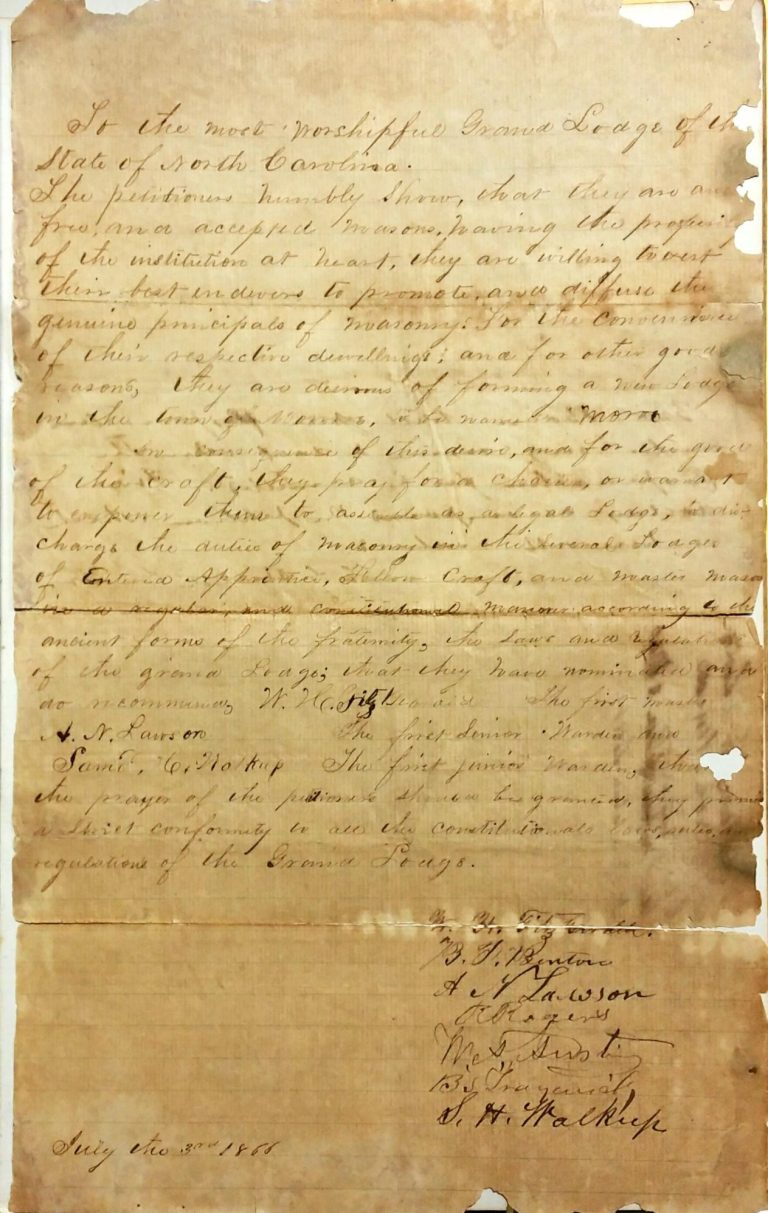
On July 3, 1866, W. H. Fitzgerald, A. M. Lawson and Samuel A. Walkup submitted a petition to the Grand Lodge of North Carolina to form a new lodge in the town of Monroe. They pledged to promote the principles of Masonry and requested a charter empowering them to assemble and work the degrees of Entered Apprentice, Fellowcraft and Master Mason.
The petitioners promised strict conformity to the constitutional laws and regulations of the Grand Lodge, and signed the document along with fellow brethren including A. N. Lawson, R. Rogers, B. S. Traywick and S. H. Walkup.
Original Letter to Grand Lodge requesting dispensation to form a Lodge. July 3, 1866
To the Most Worshipful Grand Lodge of the State of North Carolina.
The petitioners humbly show that they are Ancient Free and Accepted Masons having the prosperity of the Institution at heart. They are willing to vest their best endeavors to promote and diffuse the genuine principles of Masonry. For the convenience of these respected dwellings and for other good reason, they are desirous of forming a new lodge in the Town of Monroe, to be named Monroe in consequence of this desire and for the good of the craft. They pray for a Charter or Warrant to empower them to assemble as a legal lodge to discharge the duties of masonry in the several lodges of Entered Apprentice, Fellowcraft and Master Mason in a Regular and Constitutional manner according to the Ancient Forms of the Fraternity, the Laws and Regulations of the Grand Lodge that they have nominated and or do recommend.
W. H. Fitzgerald, First Master
A. M. Lawson, First Senior Warden
Samuel A. Walkup, First Junior Warden
That the prayer of these petitioners should be granted they promise a strict conformity to all of the Constitutional Laws, Rules, and Regulations of the Grand Lodge.
Signed
W. H. Fitzgerald
A. M. Lawson
Samuel A. Walkup
A. N. Lawson
R. Rogers
B. S. Traywick
S. H. Walkup

Bylaws were written and charter granted Dec 3rd 1866.
Officers were installed after marching in parade form to the 1st Baptist Church in Monroe.
The dispensation under which Monroe lodge was authorized to work along with a copy of the
bylaws and a transcript of the proceedings of the lodge was presented to the Grand Lodge of
North Carolina at the annual grand lodge communication at Raleigh, North Carolina on
December 3, 1866 by Worshipful Master W. H. Fitzgerald and a charter was received on
December 3, 1866 deeming, rating and constituting the said lodge a Monroe #244. Brother
Samuel Wittowski was commissioned by the deputy grand master to install the officers of
Monroe lodge.
Masonic Degrees, Lodge Concepts and Appendant bodies introduced to the USA by Monroe Masons
Most of these were imported or organized by J Ray Shute II and his companions during the late 30s.
- Council of the Allied Masonic Degrees
- Knights of the York Cross of Honor
- One of the first council of Green Degrees or Knight Masons.
- NCSCRIF (Reintroduced)
- "North Carolina Lodge of Research" The first lodge of Masonic Research in the United States to be recognized by Quatuor Coronati for its produced research.
- The Red Cross of Constantine
- Society of Blue Friars
- August Order of Light
- Pilgrim Preceptors
The Innovators & J. Ray Shute II
Monroe is the birthplace of America’s first research lodge. In 1930, J. Ray Shute II and a group of North Carolina brethren organized the North Carolina Lodge of Research, nicknamed “Nocalore.” The lodge petitioned the Grand Lodge with twenty carefully chosen founders so as not to burden Monroe Lodge No. 244. Lodge 244 approved the application, and the research lodge was granted dual membership and authority to meet anywhere in the state. During the Great Depression, members had time to collect documents and correspondence, and the lodge’s correspondence circle connected Masonic researchers around the world. Their efforts laid the foundation for many of the small Masonic bodies in North America.
From this group sprang numerous organizations that are still active today. The Innovators imported or organized degrees such as the Allied Masonic Degrees, Knights of the York Cross of Honour, Knight Masons of Ireland, Red Cross of Constantine, Societas Rosicruciana in Civitatibus Foederatis, the Holy Royal Arch Knight Templar Priests, Knights Beneficent of the Holy City, the Operatives, Order of the Bath, and the Society of Blue Friars. To preserve rare rituals they revived the Egyptian Rite of Memphis and formed the Grand College of Rites in 1932.
At the center of these achievements was J. Ray Shute II. Born in Monroe in 1904, he joined Freemasonry at 21 and served as Worshipful Master of Monroe 244 three years later. He formed the North Carolina Lodge of Research in 1931, the Grand College of Rites and the Society of Blue Friars in 1932, created the Knights of the York Cross of Honour (1930) and imported orders such as the Holy Royal Arch Knight Templar Priests, Allied Masonic Degrees, Knights Beneficent of the Holy City and Knight Masons. Shute’s leadership was equally vital to other organizations that meet at Masonic Week, and he went on to represent North Carolina’s 19th District in the state senate (1934–35) and serve two terms as mayor of Monroe.
Shute’s papers and research library are preserved today in the Shute Masonic Collection within the Southern Historical Collection at the University of North Carolina at Chapel Hill.
